Saturday, February 24, 2018
Creative Series and Parallel Circuits
Last year, knowing that I would be teaching Physical Science this year, I started collecting ideas on Pinterest for labs. One of the pins was for making circuits with aluminum foil and Christmas lights from Nitty Gritty Science. I loved the idea and had a couple of strings of old lights that weren't working reliably. I actually started to cut the lights up at the end of last year to be prepared.
I made a basic model of a series and parallel circuit to show my students and then told them to be creative. The kids certainly didn't disappoint! Most loved the process and asked if they could bring the supplies to finish up at home. They worked in class for 80 minutes, and several students had only finished the series circuit, but were still in process for the parallel circuit by the time class was over.
We began by drawing a schematic of their design. Once the design was approved, they got their supplies of a manila folder, 2 brads, a sheet of foil, scissors, several Christmas lights, a 9 volt battery, and tape. They needed reminders that tape is an insulator and to make sure the foil is always touching foil for the entire circuit.
Several parents actually commented about the popularity of this lab to me when they saw me later.
I put together directions for each table of students and also a lab sheet for them to glue into their notebooks.
Thursday, February 15, 2018
Egg Drop Challenge
As we were wrapping up our unit on forces and interactions in Physical Science, I wanted the kids to have the opportunity to apply their knowledge and also have some practice with the engineering process. For our last class before the unit test, we had an egg drop challenge.
I did some research on line, but many of the challenges out there are for students to build an apparatus at home and bring it in for the competition. Since I only see my students for one 90 minute session a week, they are busy during the week with reading the chapter and doing other assignments. I wanted students to have the opportunity to test designs and make improvements as well as practice working as a team. So, I pilfered ideas mainly from this document and put together what would be my student's in class building challenge.
Students had about 70 minutes to design and build their egg holder. Some were a little slow to start, but by the end they were all fully engaged. If I were to do this again, I'd try to figure out some way to limit the amount of glue from the glue gun used per team. I had about 7 sticks (for a full sized glue gun) and it was all used before some teams had a chance to use it even once. It was primarily one team that went hog wild with it.
In the end, of the seven teams, three of them successfully dropped their egg and had no damage to the egg. The other four were valiant attempts, all of which were exciting to watch.
Here are the directions that I gave students. It also includes the list of materials that I provided each team. All of it fit in a gallon ziplock bag. Three of the teams asked if they could use the gallon bag, and I did allow them too--even though it wasn't on their list. For students' notebooks, I gave them this reflection sheet. I also made these score sheets. These scores did not effect their lab grade, but was used to decide some fun prizes. In the end, we did not measure the distance from the target since we had to drop them on the stairs and the egg holders were flying everywhere off the steps.
Saturday, February 3, 2018
Guided Reading Questions and Videos for AP Biology
I've been meaning to put this together all year, but life has just been too busy to get it all together. Even though it's my third year teaching the new AP Biology curriculum, I've come to realize that I will never finish tweaking this course, and so will never just breeze through a year of teaching it. On the bright side, I do feel like each year I teach it a little better! Here are my links to guided reading questions and corresponding videos to supplement the reading in AP Biology. All of these links are in old blog posts, but I thought I might be easier to have all of the links in one post. Here is a link to a document that has all of these units in table form, which I like better. It just doesn't copy and paste well into blogger. Right now the chapter numbers correspond to the Campbell Biology 8th Ed., but next year we are switching to the 2nd Edition of Biology in Focus, so next year, I'll be changing the chapter numbers. I may change the questions some, but they should already match fairly well with Biology in Focus since I had chosen them based on what I saw in the Holtzclaw Test Prep review book for Campbell Biology and Biology in Focus. I love that Test Prep review book by the way!
Biochemistry: Unit 1
Chemical Context of Life
Chapter 2 Questions
Water
Chapter 3 Questions
Crash Course Water
Carbon and the Molecular Diversity of Life
Chapter 4 Questions
Crash Course Carbon
Macromolecules
Chapter 5 Questions
Crash Course Macromolecules
Enzymes
Chapter 8 Questions
Bozeman Biology Enzymes
Cells: Unit 2
A Tour of the Cell
Chapter 6 Questions
A Tour of the Cell (Bozeman)
Membrane Structure and Function
Chapter 7 Questions
In Da Club: Membranes and Transport (Crash Course)
Cell Communication
Chapter 11 Questions
Cell Communication (Bozeman)
Signal Transduction Pathways
Effects of Changes in Pathways
Metabolism: Unit 3
Introduction to Metabolism
Chapter 8 Questions
Gibbs Free Energy (Bozeman)
Cellular Respiration
Chapter 9 Questions
Cellular Respiration (Bozeman)
Photosynthesis
Chapter 10 Questions
Photosynthesis (Bozeman)
Cell Cycle and Mendelian Genetics: Unit 4 & 5
Cell Cycle
Chapter 12 Questions
Mitosis (Bozeman)
Meiosis and Sexual Life Cycles
Chapter 13 Questions
Meiosis (Bozeman)
Mendel and the Gene Idea
Chapter 14 Questions
Mendelian Genetics (Bozeman)
Heredity (Crash Course)
Chromosomal Basis of Inheritance
Chapter 15 Questions
Advanced Genetics (Bozeman)
Genetic Recombination and Gene Mapping (Bozeman)
Linked Genes (Bozeman)
Molecular Genetics: Unit 6
The Molecular Basis of Inheritance
Chapter 16 Questions
DNA Replication (Bozeman)
Gene Expression
Chapter 17 Questions
Transcription and Translation (Bozeman)
Regulation of Gene Expression
Chapter 18 Questions
Gene Regulation (Bozeman)
Viruses
Chapter 19 Questions
Viruses (Bozeman)
DNA Tools and Biotechnology
Chapter 20 Questions
Molecular Biology (Bozeman)
Genomes and their Evolution
Chapter 21 Questions
Evolutionary Development (Crash Course)
Evolution: Unit 7
Descent with Modification
Chapter 22 Questions
Natural Selection (Crash Course)
The Evolution of Populations
Chapter 23 Questions
Population Genetics: When Darwin Met Mendel (Crash Course)
The Origin of Species
Chapter 24 Questions
Speciation: Of Ligers and Men (Crash Course)
The History of Life on Earth
Chapter 25 Questions
Evolution: It's a Thing (Crash Course)
Phylogeny and the Tree of Life
Chapter 26 Questions
Taxonomy: Life's Filing System (Crash Course)
Bacteria and Archaea
Chapter 27 Questions
Old and Odd: Archaea, Bacteria, & Protists (Crash Course)
Unit 8: Plants
Plant Form and Function
Unit 9: Ecology
Animal Behavior
Ecology and the Biosphere
Population Ecology
Community Ecology
Ecosystems and Energy
Conservation Ecology and Global Change
Friday, January 19, 2018
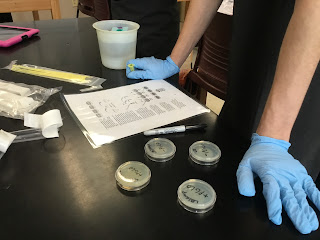
Our Best Bacterial Transformation Lab Yet
Last year when we did our bacterial transformation lab, the results were lackluster at best. We had two transformed colonies on one of the LB/amp plates and one on a LB/amp/IPTG plate. We don’t have a digital water bath, and last year I struggled to keep the 42 degree water bath at 42 degrees on the hot plate. This is a heavy preparation lab to have poor results.
The kit came in to school over the summer. I stopped by occasionally to check what orders were in. Then two weeks went by without me stopping in. When I finally came by to check, the kit was already sitting in the un-air conditioned storage room including the bag of bacteria, plasmids, ampicillin, and arabinose that says to refrigerate immediately. I took these materials out and got them into a refrigerator and started to worry that the kit was ruined even before we started. I hopped onto the Facebook group to see what people said about the kit and not refrigerating the items immediately. I was surprised at how many teachers this happened to and was relieved to see that most of them had no adverse effects.
I had also shared with a colleague about how much I would like to have a digital water bath for this lab, but felt the cost was prohibitive. She suggested we try sous vide. I did some research and found an Anova Sous Vide Immersion Circulator for $109 on Amazon with good ratings and put it on our supply order. I brought in an old pot and put the circulator in. Within 10-15 minutes I had a water bath at exactly 42 degrees Celsius that remained at 42 degrees for as long as I wanted it there.
I did make a couple of other mistakes as I prepped for the lab. I started heating the LB agar in an (Ehrlemyer) flask on a hot plate. I stepped away to rehydrate the ampicillin and arabinose and heard a sizzling noise. I looked over to the hot plate to see agar erupting out of the flask. Fortunately the hot plate wasn’t plugged in behind the plate, but to the side of it, so I quickly unplugged it (and was glad I was wearing goggles, a lab apron, and closed toe shoes). Then I was panicked that I had lost too much agar to be able to pour all of the plates. I decided to scrape as much of the agar on the counter back into the flask and simmer it for 10 minutes to make sure it was sterilized. This time I stayed with it the whole time and there were no more volcanos.
My other mistake was that I rehydrated the ampicillin and arabinose with Luria broth instead of the transformation solution (calcium chloride). It wasn’t bad for these powders, but it meant I didn’t have enough broth left for my students to use in the lab. I doled it out carefully, but for the last group, I used left-over broth from the year before. (And I'm relieved to say they still had a successful transformation.)
I am happy to report that this year, we had some of our best transformation rates. I did have two groups with no transformation, but the other four had success. We certainly can’t blame the water bath!
Fortunately, I had enough agar to pour an extra LB/amp/ara plate for each lab group. We took the non-glowing transformed colonies from the LB/amp plates and swabbed them onto the spare plates. Students were able to see how the presence of arabinose really does switch on the jellyfish green protein gene when we looked at the plates the next day. This was one of our best years for this lab!
Wednesday, January 17, 2018
Tweaking Lorenzo’s Oil
This year, AP Bio class time at my school was increased to four 80 minute blocks a week. This is up 40 minutes from last year. One of the benefits is that near Christmas we were at a good place in our curriculum and I was able to do the whole Lorenzo’s Oil movie unit in the three day week we had before Christmas break instead of splitting it before and after Break. (I blogged about this last year here.) This extra time allowed me to change things up a little. The first day, we just watched the movie. I do stop it on occasion to clarify and check for understanding. On the second day, we started with the demyelination activity. We used to do this before the very beginning of the movie, but after they’ve watched Lorenzo’s decline, the activity is more meaningful. We discussed the questions as a class and then went back to watching the movie. I was a little nervous because we only had about 30 minutes left of the movie for day 3, but we also had the competitive inhibition activity to do. I revised how we did it and loved it.
I wanted students to see how keeping the enzyme busy making unsaturated fatty acids increases the time the enzyme takes to build the C24 saturated fatty acids that were eating Lorenzo’s myelin. (Thus resulting in lower amounts of the bad saturated fatty acids in his blood.) This time, students started with a paper bag of jumbo silver paper clips (about 20 paper clips each representing 2 carbons), and a C14 fatty acid chain made of 7 joined jumbo paper clips. Each lab group timed two trials to see how long it took to build their saturated fatty acid into a C24 saturated fatty acid that was eating away at Lorenzo's myelin.
Then I gave them the original 7 paper clip chain and a 7 paper clip chain of neon paper clips to represent an unsaturated fatty acid and added about 10 neon (unsaturated) paper clips to the bag. Students timed two more trials, but this time, if they pulled a neon clip they added it to the neon chain. For the last trial, they were still timing how long it took to build a saturated C24 (silver jumbo clips), but we added another 15 neon clips to the bag. They averaged their times to build C24 for each scenario and then we looked at the class results. Maybe we'll eventually graph the means of each trial and add some errors bars.
Here are the numbers from the board.
Making Bad (C24)
| |||
all bad (in seconds)
|
some good (in seconds)
|
more good (in seconds)
| |
Group 1
|
27.2
|
78
|
78.7
|
Group 2
|
29
|
38
|
47
|
Group 3
|
34.4
|
87.5
|
63.2
|
Group 4
|
37
|
76
|
108
|
Averages (n=8)
|
31.9
|
69.9
|
74.2
|
Friday, November 24, 2017
Modeling Checkpoints in the Cell Cycle
I am always trying to find ways to make the concepts we talk about in AP Bio come to life (no pun intended), especially during the first 6 units which deal primarily with molecular biology. In class, we were working on the cell cycle, focusing on the three checkpoints and the cell regulating itself so the process of making more cells doesn't go awry. Late one night an idea popped into my head, so as my husband was trying to go to sleep, I was busy scribbling notes for a new activity on a post-it note (as seen in the picture below).
I was thinking about all the cyclin production for the checkpoints and it reminded me of the competitions I've seen in some reality TV shows. On several occasions, a team has to fill some container with water/oil/sand before they can move onto the next part of the competition. It made me think of cyclin reaching a critical level before the cell moves onto the next part of the cell cycle.
I had had enough of water messes with the labs I've done with my physical science class this year, so I couldn't bring myself to do a race that included sloshing water. Then I remembered that my classroom has inherited an unusually large number of cotton balls, so many that I'm fairly certain we can do the respirometer lab for another 100 years without needing any more cotton balls. As a result, cotton balls represented cyclin. I put together cards for each job in our cell cycle model. It begins with organelle drawing to represent the G1 phase of Interphase as the cell is growing/maturing. At the same time the first cyclin producer is adding "cyclin" cotton balls to a bucket to represent the buildup of cyclin in the cell. Once enough organelles were present and the cyclin had reached a critical level (up to a piece of tape on a bucket), the cell could move onto the next part of the cell cycle. Here the DNA was synthesized. We just had two pop-bead chromosomes that had to be replicated exactly. While the DNA was copied, a second cyclin producer was working on filling the bucket to the critical level.
If both the DNA replication completed correctly and the 2nd cyclin reached the critical level, the cell would move onto M phase through anaphase. Again, once the critical cyclin level was reached, the cell moved on, completing M phase and going though cytokinesis. And the process could continue. Also during this process, there was a cell cycle checker to make sure the cell was going through the cycle correctly and would halt cyclin production and therefore the cell cycle if anything went wrong. They could then send the cell into G0, its non-dividing state.
The link to the job cards is here.
Monday, October 23, 2017
Cellular Respiration Digital Diagram
Last year I blogged about the cellular respiration diagram that I had saved from college and use in class with my students here. After a Google training last year, I decided that I would attempt to use Google Drawings to make the respiration diagram. I spent more time than I care to admit, but got the diagram put together here and out to my students.
We worked it the same as last year. They worked on labeling the diagram first and we talked through it and even acted out oxidative phosphorylation. Then they completed their guided reading questions. Students comment each time we do it that way, how much more they understand the reading questions for this chapter.
Although it may look like there are lots of details for glycolysis and the Kreb’s cycle—for those we focus on what goes in and what comes out. We spend plenty of time discussing the significance of NAD and FAD “boats”. This year they coined NADH and FADH2 the party boats since they are full of high energy electrons.
We wrapped up our discussions today with the Mystery of 7 Deaths case study that you can find here. I loved the reasoning I was hearing!
Subscribe to:
Posts (Atom)